
Roofing Materials Guide for New Boston, TX Homeowners
Expert Roofing Materials in New Boston, TX — Storm-Tested, Warranty-Backed
Compare roofing materials for New Boston, TX — asphalt, metal, tile, TPO & more. Learn costs, lifespan & climate performance from Nunez Roofing experts.
- Licensed & Insured
- Locally Owned & Operated
- Free Inspection & Estimate
Request Your
Free EstimateChoosing the right roofing material in New Boston, TX is one of the most important decisions a homeowner can make. Located in Bowie County in Northeast Texas, New Boston sits in a region that delivers a demanding mix of climate conditions year-round. Summers bring intense UV radiation and prolonged heat that can warp, crack, or fade many roofing materials prematurely. Spring and fall seasons introduce heavy thunderstorms, significant rainfall, and the occasional severe wind event or hail storm. Winters, while mild compared to northern states, can include brief freeze-thaw cycles that stress vulnerable roofing systems. Additionally, East Texas humidity accelerates mold, algae, and moisture damage on materials that aren’t designed for humid subtropical conditions.
Fire risk is also a real consideration for homeowners with wooded properties throughout Bowie County. Selecting a fire-resistant material can affect both your safety and your homeowner’s insurance premium.
This guide breaks down every major roofing material category available to New Boston homeowners, comparing performance, lifespan, cost, and suitability for local conditions — so you can make a confident, informed decision before your next roof replacement or new installation.
Understanding Your Roofing Material Options in New Boston
New Boston homeowners have access to a wide range of roofing materials, each with distinct advantages depending on your home’s architecture, your budget, and how well the material handles Northeast Texas weather. The six primary categories you’ll encounter are asphalt shingles, architectural or dimensional shingles, metal roofing, concrete or clay tile, flat TPO membrane roofing, and modified bitumen systems.
Three-tab asphalt shingles remain the most budget-accessible option, while architectural shingles offer a significant upgrade in durability and visual appeal at a moderate price increase. Metal roofing has grown considerably in popularity across Bowie County due to its longevity and heat-reflective properties. Concrete and clay tile systems are less common but available for homeowners seeking a distinctive aesthetic. Flat roofing systems including TPO and modified bitumen are typically reserved for low-slope or commercial-style residential roofs.
In Bowie County, the City of New Boston follows the Texas residential building code, which includes minimum requirements for wind uplift ratings and fire resistance classifications. While HOA restrictions are less prevalent in rural areas surrounding New Boston, homeowners in planned subdivisions should verify approved material types and colors before committing to a selection. A licensed roofing contractor familiar with local requirements can help you navigate these considerations before any work begins.
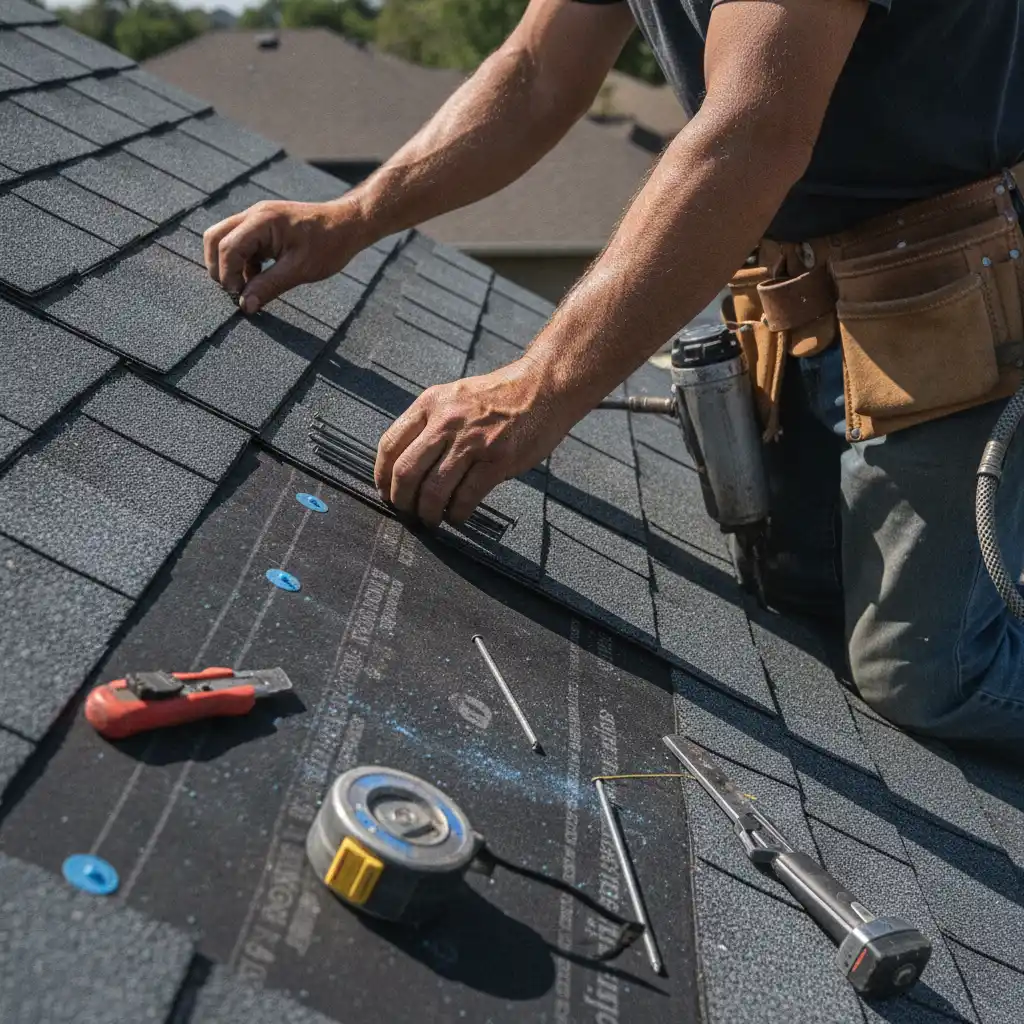
Our team in action — roofing professionals serving New Boston
How New Boston’s Climate Affects Your Roofing Material Choice
New Boston’s position in Northeast Texas means your roof faces a combination of climate stressors that require careful material matching. Understanding how each local factor affects roofing performance helps you prioritize what matters most for your home.
UV Intensity and Heat: Texas summers expose roofing materials to relentless solar radiation and temperatures that can push roof surface temps well above 150°F. Metal roofing and TPO membranes are best equipped to reflect this heat. Architectural shingles with Cool Roof-rated granules are a good mid-budget compromise.
Rainfall and Moisture: Bowie County averages around 48 inches of rainfall annually, with heavy thunderstorm events concentrated in spring and fall. Proper drainage and water-shedding materials are critical. Metal, architectural shingles, and TPO all perform well in high-rainfall environments.
Wind and Hail: Severe storms tracking through Northeast Texas can produce 60–80+ mph wind gusts and large hail. Architectural shingles with Class 4 impact ratings and standing seam metal systems offer the best protection. Tile can crack under direct hail impact.
Fire Risk: Wooded properties in Bowie County face meaningful wildfire exposure risk. Class A fire-rated materials — metal, tile, and certain asphalt shingles — are strongly recommended for homes with significant tree coverage.
Humidity and Algae: East Texas’s humidity encourages algae and mold growth on roofing surfaces. Copper-infused or algae-resistant shingles, metal panels, and tile are your best defenses against unsightly and damaging biological growth.
Roofing Materials Available in New Boston, TX
Asphalt Shingles (3-Tab)
Three-tab asphalt shingles are the most economical roofing option and remain widely installed throughout New Boston and surrounding Bowie County communities. They consist of a flat, single-layer design with cutouts along the lower edge that give the appearance of three separate shingles. While affordable, they are thinner and less durable than architectural options, making them more susceptible to wind damage during the strong spring storm systems common to Northeast Texas. UV exposure and the region’s high summer temperatures can also shorten their effective lifespan. Pros: Low upfront cost, widely available. Cons: Shorter lifespan, less wind resistance, prone to UV degradation. Typical lifespan in New Boston conditions: 15–20 years. Approximate cost range: $80–$120 per square installed.
Architectural / Dimensional Shingles
Architectural shingles, also called dimensional or laminate shingles, are a significant step up from standard three-tab products. They feature a multi-layer construction that creates a textured, shadow-effect appearance resembling wood shake or slate, while offering superior performance for New Boston’s climate. Many architectural shingles are rated for winds up to 110–130 mph, which is critical during severe thunderstorm season in Bowie County. Their added thickness also provides better resistance to hail impacts and UV degradation from Texas’s intense summer sun. Algae-resistant granule coatings help combat East Texas humidity-related growth. Pros: Better wind and hail resistance, longer life, aesthetic appeal. Cons: Higher cost than 3-tab. Typical lifespan: 25–30 years. Approximate cost range: $130–$200 per square installed.
Metal Roofing
Metal roofing systems — including standing seam panels and metal shingles — have become increasingly popular throughout Northeast Texas for good reason. Metal excels in New Boston’s climate by reflecting solar radiation to reduce cooling loads during brutal summer months, resisting high winds common to severe storm seasons, and shedding rainfall efficiently to prevent water intrusion. Steel and aluminum options resist rust and corrosion well in East Texas’s humid conditions. Metal is also Class A fire rated, an important consideration for wooded properties in Bowie County. The higher initial investment is typically offset by the dramatically extended lifespan. Pros: Exceptional durability, energy efficiency, fire resistant, low maintenance. Cons: Higher upfront cost, can be noisy during heavy rain without proper underlayment. Typical lifespan: 40–70 years. Approximate cost range: $300–$600 per square installed.
Concrete or Clay Tile
Concrete and clay tile roofing systems offer a distinctive Mediterranean or Spanish Colonial aesthetic that suits certain architectural styles. Clay tile is exceptionally resistant to UV degradation and heat, which plays in its favor during New Boston’s hot summers. However, tile is heavy — requiring confirmed structural support — and can be vulnerable to the occasional hard hail event that impacts Northeast Texas. Concrete tile offers comparable performance at a lower price point than natural clay. Freeze-thaw cycles in Bowie County are relatively mild but can crack lower-grade tiles over time. Installation requires specialized expertise. Pros: Longevity, fire resistance, UV resistance, distinctive appearance. Cons: Heavy, expensive, hail vulnerability, limited installer availability locally. Typical lifespan: 40–50 years. Approximate cost range: $350–$550 per square installed.
Flat / TPO Roofing
Thermoplastic Polyolefin (TPO) is the leading flat or low-slope roofing membrane system used on residential additions, sunrooms, and commercial-style properties in the New Boston area. TPO membranes reflect UV radiation effectively, helping reduce interior cooling costs during Texas summers — a notable advantage in the region. The heat-welded seams create a watertight surface critical for handling Northeast Texas’s seasonal heavy rainfall. TPO is lightweight, chemical resistant, and environmentally friendly. It does require professional installation and periodic inspection to maintain seam integrity. Pros: Energy efficient, watertight, lightweight, cost-effective for low-slope applications. Cons: Not suitable for steep-pitch roofs, requires professional maintenance. Typical lifespan: 20–30 years. Approximate cost range: $200–$350 per square installed.
Modified Bitumen
Modified bitumen is an asphalt-based flat roofing system reinforced with polyester or fiberglass for added strength. It is commonly applied in two-layer systems using either torch-down, cold adhesive, or self-adhesive methods. Modified bitumen performs well in New Boston’s climate due to its flexibility in temperature extremes — accommodating the region’s hot summers and occasional winter cold snaps — and its resistance to pooling water from heavy thunderstorm rainfall. It is a proven, cost-effective solution for flat and low-slope roofs on older homes and outbuildings throughout Bowie County. Pros: Durable, flexible across temperatures, good waterproofing. Cons: Requires professional installation, darker surface absorbs more heat. Typical lifespan: 15–20 years. Approximate cost range: $150–$280 per square installed.
Ready for Roofing Materials? Get Your Free Estimate Today.
Nunez Roofing serves New Boston and the surrounding area — we’ll be on-site within 24 hours.
📞 Call (903) 326-7470Why New Boston Homeowners Trust Nunez Roofing for Material Selection
Selecting the right roofing material is only half the equation — proper installation by a qualified local contractor determines whether that material actually performs as promised. Nunez Roofing brings the experience and credentials New Boston homeowners need to make confident, well-supported decisions.
Roofing Materials FAQ for New Boston Homeowners
What is the best roofing material for New Boston’s climate?
For most New Boston homeowners, architectural dimensional shingles or metal roofing offer the best balance of performance and value given the region’s heat, UV intensity, rainfall, and storm risk. Metal is the top performer for longevity and energy efficiency. Architectural shingles provide excellent performance at a lower upfront cost. The right answer depends on your budget, your home’s structure, and your long-term plans.
How do roofing material costs compare in New Boston, TX?
Three-tab asphalt shingles are the most affordable at roughly $80–$120 per square installed. Architectural shingles run $130–$200 per square. Metal roofing ranges from $300–$600 per square depending on the panel system. Tile systems fall between $350–$550 per square. Flat roofing materials like TPO run $200–$350 per square and modified bitumen $150–$280 per square. These are general estimates — your actual cost depends on roof size, pitch, and current material removal requirements.
How long will a new roof last in New Boston, TX?
Lifespan varies significantly by material and installation quality. Three-tab shingles typically last 15–20 years in Northeast Texas conditions. Architectural shingles average 25–30 years. Metal roofing can last 40–70 years. Tile systems last 40–50 years. Flat TPO membranes last 20–30 years and modified bitumen 15–20 years. Proper ventilation, underlayment, and installation quality are critical factors that affect actual lifespan regardless of the material selected.
Do I need HOA approval before replacing my roof in New Boston?
Not all New Boston neighborhoods have active HOA oversight, but if your home is in a planned subdivision with an active HOA, approval for material type and color may be required before work begins. HOAs typically regulate visible roofing materials to maintain neighborhood aesthetics. Your contractor should help you identify applicable restrictions and obtain necessary approvals before installation begins to avoid costly compliance issues.
Which roofing materials are most energy efficient for New Boston summers?
Metal roofing — particularly with reflective Kynar or PVDF coatings — offers the highest solar reflectance, which can meaningfully reduce attic temperatures and cooling costs during New Boston’s hot summers. TPO membranes are also highly reflective and excellent for flat roofs. Among asphalt options, architectural shingles with Cool Roof-rated granule coatings carry Energy Star certification and reflect more solar energy than standard shingles, reducing heat transfer into your living space.
What fire rating should I look for in a roofing material in New Boston?
Class A is the highest fire resistance rating under ASTM E108 testing and is strongly recommended for New Boston homeowners, especially those with wooded lots in Bowie County where wildfire risk is a realistic concern. Metal roofing, clay and concrete tile, and many architectural shingle products carry Class A ratings. Three-tab shingles may carry Class A ratings depending on the product — always verify fire rating specifics before purchasing. A higher fire rating can also positively impact your homeowner’s insurance premiums.
Is metal roofing worth the higher upfront cost in New Boston?
For many homeowners planning to stay in their home long-term, metal roofing’s higher upfront cost is justified by its dramatically longer lifespan, lower maintenance requirements, energy savings, superior storm resistance, and Class A fire rating. Over a 40–50 year span, a single metal roof installation often costs less than two or three asphalt shingle replacements combined. For homeowners with shorter time horizons or tighter budgets, high-quality architectural shingles remain an excellent and cost-effective alternative.
Can I install a new roofing material over my existing shingles in New Boston?
Texas building codes and most manufacturer warranties require a full tear-off of existing roofing materials before installation of a new system in most cases. While a second layer of shingles is sometimes permitted where only one layer exists, adding weight to the decking, trapping moisture, and voiding manufacturer warranties are significant risks. A proper tear-off also allows inspection and repair of the underlying decking — critical after the kind of hail and wind events common to Northeast Texas.
Get Expert Roofing Material Advice in New Boston
Not sure which roofing material is right for your home, budget, and New Boston’s demanding climate? Nunez Roofing offers free, no-obligation material consultations for homeowners throughout Bowie County and the surrounding area. Our experienced team will walk you through every material option, explain how each one performs in local conditions, and help you match the right choice to your specific roof structure and long-term goals — without any pressure to buy.
Call Nunez Roofing today at (903) 326-7470 to schedule your free roofing material consultation. We’re proud to serve New Boston, TX and the surrounding communities with honest, expert guidance and quality installations that stand up to everything Northeast Texas weather delivers.